

By Regina Lalam Olal
KAMPALA, Uganda — October 21, 2026
Uganda’s controversial charcoal ban has sparked nationwide debate, with Parliament suspending enforcement of the restrictions pending a government explanation on the availability and affordability of alternative cooking fuels for ordinary citizens.
The controversy follows renewed security operations against charcoal dealers and transporters in Northern Uganda, West Nile, Karamoja and the Teso sub-region, where commercial charcoal production and trade are restricted under Presidential Executive Order No. 3 of 2023.
The crackdown has raised concerns among traders, transporters and households that depend on charcoal for cooking and income.
Parliament suspends enforcement
On October 14, 2026, Speaker of Parliament Jacob Marksons Oboth directed the government to suspend enforcement of the charcoal ban until the responsible ministry presents a comprehensive statement to Parliament on the implementation of the restrictions and the progress made in promoting alternative energy sources.
The directive followed concerns raised by Leader of the Opposition Joel Ssenyonyi, who questioned whether the government had done enough to ensure that affordable cooking alternatives were available before intensifying enforcement.
Ssenyonyi warned that abrupt restrictions could place additional pressure on millions of Ugandans who depend on charcoal and firewood for their daily cooking needs.
Government Chief Whip Jane Ruth Aceng also called for a phased approach, arguing that the transition to alternative cooking fuels requires coordination among government agencies and meaningful public engagement.
Police clarify that the ban is not nationwide
The Uganda Police Force has clarified that the restrictions do not amount to a nationwide ban on charcoal production and trade.
Police spokesperson Kituuma Rusoke said on October 19 that the presidential directive specifically covers Northern Uganda, West Nile, Karamoja and the Teso sub-region.
The clarification follows public concern and confusion after police warned that people transporting charcoal, including small quantities, could face enforcement action.
According to police, the restrictions are intended to curb illegal charcoal production and trade in the affected regions, where extensive tree cutting has contributed to environmental degradation.
However, the parliamentary directive to suspend enforcement has introduced uncertainty over how the restrictions should be implemented while the government prepares its response.
Despite the controversy, security agencies have continued to report enforcement operations.
According to the Uganda Police Force, joint operations conducted in Amuru and Pakwach districts this month October , resulted in the recovery of over 200 bags of charcoal and the arrest of two suspects.
In Amuru District, officers impounded 260 bags during operations in Pabbo Town Council, Opara Sub-county and Atiak Town Council. Another 15 bags were seized along the Pakwach–Nebbi Road in Alwi Sub-county, Pakwach District.
Police have warned motorists and traders against transporting or selling charcoal in violation of the restrictions, including displaying charcoal for sale along highways.
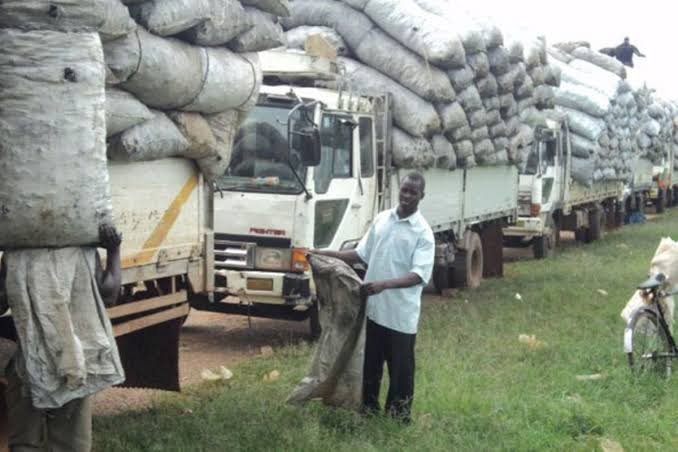
Filed Photo Trailer loaded with Sacks of charcoal
The continued enforcement activity has raised questions about how the suspension directed by Parliament is being applied on the ground.
Charcoal traders count their losses
The crackdown has also affected people whose livelihoods depend on the charcoal business.
Charcoal traders operating along Uganda’s border with South Sudan have appealed to President Yoweri Museveni for a three-month grace period to sell their existing stocks.
The traders argue that they invested substantial amounts of money in stocks that they can no longer transport or sell freely under the intensified restrictions.
Government promotes alternative cooking fuels
The government has defended the shift towards cleaner cooking technologies, including liquefied petroleum gas (LPG), electric cooking, ethanol, biogas and fuel briquettes.
State Minister for Mineral Development Phiona Nyamutooro has said that alternative cooking options should not be limited to gas and electricity, pointing to other fuels that can be produced using locally available materials.
The government has also promoted LPG starter kits and measures intended to encourage electric cooking.
However, critics argue that providing cooking equipment alone is insufficient if households cannot afford recurring fuel costs or access reliable energy supplies.
The debate has therefore shifted beyond environmental protection to questions of household welfare, affordability and the readiness of the country to move away from traditional cooking fuels.
Environmental protection versus household survival
Environmental campaigners have long raised concerns about indiscriminate tree cutting for commercial charcoal production, warning that forest loss threatens biodiversity, agricultural productivity and the livelihoods of communities that depend on natural resources.
At the same time, charcoal remains an important source of energy and income for many Ugandan households and small businesses.
The challenge facing policymakers is how to reduce destructive commercial charcoal production without imposing an abrupt economic burden on vulnerable communities.
A sustainable response could require affordable alternative fuels, stronger protection of forests, public awareness campaigns and a clear distinction between large-scale commercial production and household energy needs.
0 Comments
Be the first to share your thoughts on this story.